Most speech AI platform evaluations start in the wrong place.
Teams look at marketing demos. They check whether a platform transcribes clean English well. They compare pricing tiers. Then they pick something and build on it. A few months later they discover it does not work on their actual audio, in their actual languages, under their actual compliance requirements.
The problem is not that those teams made bad decisions. It is that they evaluated the wrong things.
A speech AI platform that works brilliantly for a US-based SaaS company can fail completely for an Indian BFSI enterprise. Not because the platform is bad. Because the fit was wrong from the start.
This guide covers the six criteria that actually determine whether a speech AI platform works in production. Each one has a concrete test you can run before you commit to anything.
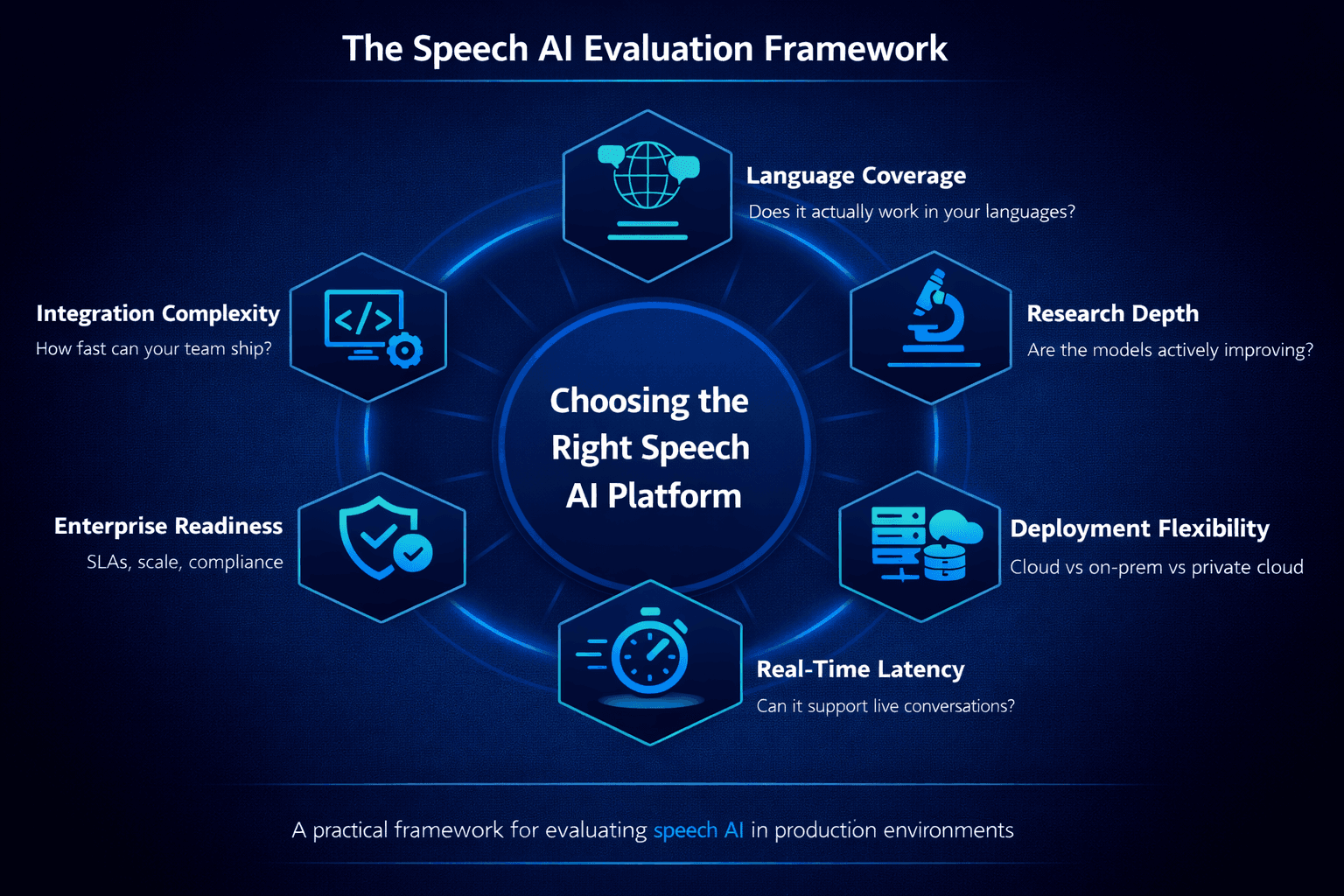
Criterion 1: Language Coverage That Matches Your Users
Language support is one of the most misrepresented metrics in speech AI. A platform that claims to support 50 languages is not the same as a platform that works well on 50 languages.
The difference lies in how each language was trained. Global platforms add languages by extending their English-first models. That works for languages with large clean audio datasets: German, French, Mandarin, Spanish.
It does not work when training data is thin, dialect variation is high, or real deployment audio looks nothing like studio recordings. That describes most Indian languages.
For India, this gap is especially wide. The country has 22 official languages and hundreds of dialects. Code-switching between languages mid-sentence is standard for millions of speakers. A model trained primarily on English and extended to Hindi does not handle Bhojpuri, Marathi, or Telugu telephony speech reliably.
So the question to ask is not how many languages a platform supports. It is: which languages were trained on real-world audio in real deployment conditions, and what is the word error rate on those languages measured independently?
What to test
Request WER data specifically for your target languages on telephony-quality audio, not studio recordings.
Ask whether the model was trained on code-switched speech if your users mix languages mid-sentence.
Run a blind test: record a few minutes of audio from your actual callers and test every shortlisted platform on the same file.
Platforms trained on real-world audio for a language will perform significantly better than those that have extended English-first models.
Shunya Labs models cover 200 languages including 55 Indic languages. Each Indic language is trained on real audio, code-switched speech, and regional dialect variation, not extended from an English base.
Criterion 2: Research Depth Behind the Models
Every speech AI platform has models. Not every platform has a research programme that is actively improving those models based on how they actually fail in production.
The distinction matters more than it might seem. Speech AI is not a solved problem. Real-world audio is noisy, compressed, and full of domain-specific vocabulary that general models have never seen. A platform built on top of commodity models from three years ago will hit accuracy ceilings that a research-led platform can push past.
Research-led platforms publish papers, benchmark against independent datasets, and improve their architectures continuously. You can see it in their model versioning history and their domain-specific vocabulary performance. Are they shipping new architectural approaches, or just repackaging existing ones?
The practical test is simple: ask the vendor what changed between their last two model versions and what specific problem each change solved. A vendor with a real research programme can answer that precisely. A vendor reselling a commodity model usually cannot.
What to look for
Published research papers and benchmarks, especially on non-English and low-resource languages. Model architecture that reflects recent advances, not just fine-tuned versions of 2022-era models. A clear roadmap for specific language improvements, not generic promises of ‘continuous improvement’. Benchmark results on independent third-party datasets, not just internal evaluations.
Zero STT by Shunya Labs is the most accurate speech recognition model on OpenASR benchmarks, achieving 3.10% World Error Rate (WER). The Indic language models were not adapted from English. They were built from the ground up on Indic audio data, which is why we achieve 3.1% WER on Indian speech where global platforms struggle.
Criterion 3: Deployment Flexibility for Regulated Industries
This is the criterion that eliminates the most platforms fastest, especially for Indian enterprise.
Regulated industries like BFSI and healthcare cannot route audio to infrastructure they do not control. Under PDPB guidelines and RBI circulars, audio from Indian customer calls generally cannot leave India. Under HIPAA-equivalent frameworks in healthcare, patient audio must stay within defined boundaries.
Most global speech AI platforms are cloud-only. You send audio to their US or EU servers, you get a transcript back. That architecture is simply not compliant for Indian BFSI or healthcare regardless of how good the transcription quality is.
The platforms that work in regulated contexts offer one of three things. On-premise deployment, where the model runs on your own hardware. India-hosted infrastructure, where audio stays within Indian data centres. Or private cloud within a defined boundary you control.
Ask your vendor three specific questions. Is the on-premise model the same version as the cloud model? Does it support streaming ASR? Can it run on CPU hardware without GPU infrastructure?
What to ask your vendor
Is on-premise deployment available, and is it the same model as the cloud version?
Does it support streaming ASR in on-premise mode?
Can it run on CPU-only hardware, or does it require GPU servers?
What is the minimum hardware specification for a production deployment at your expected concurrent load?
Is India-hosted cloud infrastructure available as an alternative to on-premise?
Zero STT runs fully on-premise on CPU hardware, with no GPU requirement. This is the architecture that makes it viable for BFSI and healthcare teams in India who cannot route audio outside their own infrastructure.
If you are building anything interactive, latency is not a performance metric. It is a product requirement.
Human conversation has a natural response window of 200 to 300 milliseconds. When a voice agent exceeds that, the interaction can start to feel broken. Users talk over the agent. Trust drops. Task completion falls.
There are two latency numbers to care about. The first is streaming STT time-to-first-token: how quickly the ASR layer returns text after audio starts arriving. This should ideally be under 500 milliseconds for production real-time applications. The second is end-to-end turn latency: from the user stopping speaking to the agent starting its response. This should be under 800 milliseconds for natural conversation.
Most vendor latency claims are measured in ideal conditions: clean audio, fast networks, small models. Real Indian deployments add variables that inflate those numbers. Telephony audio compression. India-to-US network round-trips can add 180 to 250 milliseconds per turn. On-device inference removes the network round-trip entirely, which is why it consistently beats cloud-routed alternatives for Indian field operations and contact centre use cases.
What to measure
Streaming STT time-to-first-token: should be under 500ms. Test on your actual audio format, not a clean demo file.
End-to-end turn latency: should be under 800ms for live conversation. Measure from end of speech to start of agent audio.
Measure at your expected peak concurrent load, not on a single test call.
For India deployments: measure latency with India-origin audio.
Criterion 5: Enterprise Readiness Beyond the Demo
There is a significant gap between a platform that works in a proof-of-concept and one that works at production scale in an enterprise environment.
Enterprise readiness covers several things that often do not show up in a demo. Concurrent connection limits: how many simultaneous calls can the platform handle before quality degrades? SLA terms: what uptime is guaranteed, and what compensation exists if it is not met? Support response times: when something breaks at 2am before a launch, who answers?
For Indian enterprise specifically, there are additional dimensions. Does the vendor have experience with Indian audio at scale? Can they provide Indian reference customers in your vertical? Do they understand the specific compliance requirements of RBI, IRDAI, or the healthcare data frameworks you operate under?
A vendor who has only shipped to US enterprises will know the HIPAA and SOC 2 landscape well. They will not necessarily know how Indian BFSI compliance maps to deployment architecture, or what audit documentation Indian regulators expect. That knowledge gap creates risk.
Enterprise checklist
Concurrent call capacity at your expected peak load, with documented degradation behaviour above that limit.
SLA with uptime guarantees and clear remediation terms, not just ‘best effort’.
Support tier that includes named contacts and response time commitments for production issues.
Reference customers in your vertical and geography, not just logo references.
Compliance documentation relevant to your regulatory framework, not just generic SOC 2 or GDPR certification.
Criterion 6: Integration Complexity and Time-to-Production
A platform that takes three months to integrate is not a good platform for teams with a six-month roadmap.
The integration complexity question covers two things. First, the API design: is it REST or WebSocket? For streaming ASR, WebSocket is standard and integrates in hours. Complex authentication schemes like AWS Signature V4 or proprietary gRPC can add weeks to integration timelines, especially for teams without deep cloud experience.
Second, SDK quality. A well-maintained SDK with working examples cuts integration time from weeks to days. Ask to see it before you commit. Run the quickstart. If it takes over an hour to get a working transcription from a test file, that can tell you something about the full integration experience.
For voice agent applications, also ask about the full pipeline. Does the platform provide just ASR, or does it offer a complete STT-plus-LLM-plus-TTS pipeline? If you need to wire three separate vendors together, you own the integration surface and every latency problem at each handoff. Some teams prefer that control. For others, a unified pipeline is worth the reduced flexibility.
Integration signals to watch
WebSocket API for streaming ASR: integrates in hours. Complex auth schemes: add days to weeks.
Working SDK quickstart that runs in under an hour.
Active documentation with examples in your language stack.
Clear answer on whether pipeline components (STT, LLM, TTS) can be used independently or only as a bundle.
Criterion 6: Integration Complexity and Time-to-Production
How Leading Platforms Compare on These Six Criteria
This table uses publicly available information and is accurate as of March 2026. Enterprise features and pricing change frequently. Verify with vendors before making a final decision.
| Platform | Indic Language Support | Research-Led Models | On-Premise / CPU | Streaming Latency | India Enterprise Focus | Integration Ease |
|---|---|---|---|---|---|---|
| Shunya Labs | 200 languages, 55 Indic (deep) | Yes | Yes, CPU-only | Excellent, Sub-50ms on-device | Yes | Excellent WebSocket |
| Deepgram | Limited (English-first) | Yes, active research | Yes (GPU required) | Excellent | No | Excellent |
| Azure Speech | Hindi, some Indic | Large scale, broad | Yes (GPU required) | Good | Partial | Good |
| Google STT | 22 languages (limited depth) | Broad, English-first | Via Anthos (complex) | Good | No | Good |
| AssemblyAI | Very limited | Yes, active research | Yes (self-hosted) | Good | No | Good |
| Speechmatics | Limited | Yes, strong research | Yes | Excellent | No | Good |
Frequently Asked Questions
What is the most accurate speech AI platform for Indian languages?
Accuracy on Indian languages depends entirely on which languages you need and what audio conditions you are working with. For standard Hindi in clean audio, most major platforms perform acceptably. For regional Indian languages like Telugu, Marathi, Bhojpuri, Odia, or Assamese over telephony audio, platforms specifically trained on Indic data perform significantly better. The only reliable way to measure this is to test on your actual audio, not rely on vendor-provided benchmarks. Shunya Labs is one of the platforms that has high accuracy in Indic languages.
Can a speech AI platform run without sending audio to the cloud?
Yes, several platforms offer on-premise deployment. The important check is whether the on-premise version uses the same model as the cloud version and whether it supports streaming ASR. Some vendors offer on-premise as a reduced-feature option, which is worth clarifying before you build your architecture around it. CPU-first on-premise deployment, which runs without GPU hardware, is the most practical option for most Indian enterprise teams.
How many languages does a speech AI platform need to support?
The number matters less than which languages and how well. A platform that supports 10 languages with production-grade accuracy on real-world audio is more useful than one that supports 100 languages at inconsistent quality. For India, a practical enterprise deployment often needs 5 to 10 specific Indic languages at high accuracy, plus Indian-accented English. Start with your actual user distribution and work backwards to the language requirement.
What should I prioritise when choosing between a specialised platform and a big cloud provider?
Big cloud providers win on ecosystem integration, geographic coverage, and compliance certifications for Western regulatory frameworks. Specialised platforms win on accuracy for specific domains or languages, deployment flexibility, and typically on latency. For Indian enterprise teams who need Indic language accuracy, on-premise deployment, and a vendor who understands Indian compliance requirements, a purpose-built platform is almost always the better choice. The integration and ecosystem tradeoffs are real, but they are usually solvable. The language accuracy gap is much harder to close after deployment.
The Evaluation Framework in Summary
Run through these six questions before you shortlist any speech AI platform:
- •Does it support your specific languages at production-grade accuracy on real-world audio, not just in demos?
- •Is there genuine research behind the models, or is it a fine-tuned commodity model with a marketing layer?
- •Can it run on-premise on CPU hardware, with the same model and streaming support as the cloud version?
- •What is the measured end-to-end latency on your actual audio format at your expected call volume?
- •Does the vendor have enterprise-grade SLAs, support, and reference customers in your vertical and geography?
- •How long does integration actually take? Run the quickstart before you commit.
The platforms that clear all six bars are a short list. That is the point. Better to know that before you build than six months into a production deployment.
Leave a Reply